우리는 윤리적인 것을 믿으며 살아갈 수 있는가? 타자를 받아들인다는 말이 듣기엔 좋지만, 그 말 뒤엔 늘 낯설고 불쾌한 것에 대한 공포가 숨겨져 있다. 접촉은 단순한 감각이 아니라, 어떤 존재를 받아들이고 밀어내는 감각의 정치적 문법이다. 우리는 누구와 마주치고, 무엇을 꺼리고, 어떤 더러움을 참을 수 있으며, 어떤 방식의 사랑을 감각할 수 있을까?
코로나 시기, 그런 질문들이 전 세계적으로 일상화되었다. 사람들의 손길이 닿은 손잡이를 피하고, 타인의 호흡과 눈빛조차 꺼리는 감각이 퍼졌다. 그건 단순히 바이러스 때문만은 아니었다. 그보다 더 깊은 층위에서, 타자에 대한 불안과 통제 불가능성, 더러움에 대한 원초적 혐오가 발현된 것이다. 그리고 그 혐오는 누구에게나 향할 수 있었다. 어느 날은 특정 지역, 특정 세대, 특정 집단 등. 나 역시 그런 혐오를 받아도 보고 해보기도 했던 것 같다. 당시 나의 나이는 젊은 20대였으니 코로나에 걸려도 사실상 엄청난 문제가 발생하진 않겠지만, 모든 것들이 제한되고 통제된 상황에서 한순간 차라리 죽을 사람들은 죽어버렸으면 좋겠다고 생각한 적도 있다. 그건 당연히 매우 혐오적인 발언이고 끔찍한 상상이라는 걸 알았지만, 적자생존의 원칙처럼 세상의 일부 문제는 또 해결되지 않는가라 생각해 보았다. 정치도 젊어지겠지 생각했다. 인구문제, 복지 문제, 각종 소수자 및 약자의 문제 등. 약자를 버리고 약자의 손을 들어준다.
할머니에게 안부전화를 걸고있으면서 스스로도 모순점이 있는 생각들이 들었고 다시 이런 생각의 파편들을 버렸다. 아무렇지 않은 것처럼. 언제나 세상은 알맞고 평화롭고 적당하게 돌아가는 것처럼. 아무도 여기에선 불합리하게 죽지 않을 것처럼. 그러나 결국 이 모든 고통으로부터 해방된 건, 아이러니하게도 전 지구가 그로부터 충분히 감염되었을 때였다. 모두가 더러워졌을 때 면역체계를 만들고 그로 인해 다시 건강과 안정적인 삶을 얻었다. 깨끗함은 어떤 회복도 만들어내지 못한다. 우리는 오히려 오염됨으로써 살아갈 수 있는 존재들인지도 모른다.
이런 생각의 지점에서 나는 '교환 실험'을 시작했다. 아름다운 꽃다발을 만들고 그것을 돈이 아닌 어떤 타인의 물건과 교환하는 게임. 과연 그것은 단순한 낭만일까? 실제로 당근 앱으로 이루어진 처음 10회의 교환은 모두 여성들과 이루어졌다. 대부분 중년층의 여성들이었다. 나이가 들수록 화려한게 좋아진다며, 크리스마스에 반짝이와 빨간 안료가 묻어져나오는 꽃을 잔뜩 사들고 온, 그러나 티끌 하나 없이 하얀 달항아리를 차는 어느 미대 교수의 말이 떠올랐다.
나는 계속해서 레이어를 덧입힌 꽃을 염색해서 꽃다발들을 만들었고 이 놀이에 어느 정도 심취했다. 나 스스로도 웃긴 교환. 적당히 아름답고 적당히 우스우며 적당히 노골적인. 자연스럽기보다는 조금 더 화려한 색을 입은 꽃들처럼! 돈이 아닌 당신의 어떤 코딱지 하나의 몸 잔여라도 갖고 싶어요. 나는 과잉되고 화려하면서 낭비적이고 가벼운 미학을 담은 낭만 안에서, 또 여기저기 때 묻은 더러움에도 불구하고 기어이 그것을 얻어내고 뛰어들려 하는 수상함 속에서 관능성을 바라다본다. 관능의 주체는 'Give’ 하는 동시에 분명 ‘Take’ 한다.
마로니에와 홍대 앞을 서성이며 점점 더 간절해지는 보부상 장사꾼이 된 나는 한편 혐오스런 마츠코를 떠올렸다. 어떤 시선에서는 그녀가 스스로를 우스운 방식으로 무너트리는 것 같아도 보이지만, 나에게 그녀는 단순히 수동적인 인물이 아니라, 그녀 스스로가 무한한 동력을 가지고 일어서서 사랑하고 접촉하고 감각하는 능동적 주체로 그려진다. 교환실험에서의 염색한 꽃, 화려한 표면, 가벼운 장식, 아주 가볍지는 않은 접촉. 때로는 사고파는 행위처럼 간절하기도 하고, 무엇이든 받아내는 손과 기꺼이 그 손에 물들여주는 꽃다발. 나는 이 오염 속에서 또 다른 자발적 더러움을 마련하고 관능을 만들어낸다. 타인을 깨끗이 이해하는 것이 아니라 감각이 침투하고 몸이 녹으며, 새로운 리듬을 만들어내는 상태. 그리고 이곳에서 꽃과 비누를 매개로 사용한다.
Can we trust what we believe to be ethical? The idea of accepting others sounds good, but behind it always lurks a fear of what is unfamiliar and unpleasant. Touch is not simply a sensation; it is a political grammar of the senses through which we accept certain beings and push others away. Whom can we encounter, what do we recoil from, what kinds of dirt can we tolerate, and what forms of love are we capable of sensing?
During the COVID-19 pandemic, such questions became part of everyday life across the world. People avoided door handles touched by other hands, and a growing aversion extended even to the breath and gaze of others. This was not simply because of the virus. At a deeper level, it brought to the surface our anxiety toward others and what cannot be controlled, along with a primal disgust toward dirt. And that disgust could be directed at anyone: one day at a particular region, another at a particular generation or group. I think I, too, both received and participated in such disgust.
I was in my early twenties at the time, young enough that contracting COVID would most likely not have caused me serious harm. Yet with everything restricted and controlled, there was a moment when I thought it might simply be better if those who were going to die just died. I knew, of course, that this was a deeply hateful thing to say and a horrible thing to imagine. Still, I wondered whether, by something like the principle of survival of the fittest, some of the world’s problems might then resolve themselves. Politics would become younger, I thought. Problems of population, welfare, minorities, and the vulnerable. Abandon the vulnerable, and take the side of the vulnerable.
Even as I called my grandmother to ask how she was doing, these contradictory thoughts passed through my mind. Then I discarded their fragments again, as though nothing had happened. As though the world always moved along at an appropriate, peaceful, reasonable pace. As though no one here would ever die an unreasonable death. And yet, ironically, release from all this suffering came only once enough of the world had been infected. Once everyone had become dirty, we developed immunity and, through it, regained health and a more stable life. Cleanliness produced no recovery. Perhaps we are beings who survive precisely by becoming contaminated.
With these thoughts in mind, I began the “Exchange Experiment”: a game in which I made beautiful bouquets and exchanged them not for money, but for an object belonging to someone else. Was it simply a romantic gesture? The first ten exchanges, arranged through the Karrot app, were all with women, most of them middle-aged. I remembered an art professor who makes immaculate white moon jars, without so much as a speck on them, once saying that he found himself drawn to more flamboyant things as he got older. One Christmas, he came in carrying armfuls of flowers covered in glitter and red pigment that rubbed off at the touch.
I kept dyeing flowers in layer upon layer of color, making them into bouquets, and became somewhat absorbed in the game. An exchange that I myself found funny: adequately beautiful, adequately ridiculous, adequately blatant. Like flowers dressed in colors a little more flamboyant than anything natural! Instead of your money, I want some tiny bodily remnant of yours—even a single booger. Within a romance shaped by an excessive, flamboyant, wasteful, and lighthearted aesthetic, I look toward sensuality in the suspicious determination to obtain something and plunge into it despite all the dirt picked up along the way. The sensual subject clearly "Takes" at the same time as they "Give".
As I wandered around Marronnier Park and the streets of Hongdae, becoming an increasingly desperate peddler, I found myself thinking of Matsuko from the film Memories of Matsuko. From one point of view, she may appear to destroy herself in absurd ways. To me, however, she is not simply a passive figure, but an active subject with an inexhaustible drive of her own—the capacity to rise again, to love, to touch, and to feel.
The dyed flowers of the Exchange Experiment, flamboyant surfaces, light decorations, and contact that is not quite so light. At times there is a desperation to it, almost like buying and selling: a hand willing to take whatever it is given, and a bouquet willing to dye that hand in return. Within this contamination, I create another form of voluntary dirtiness and produce sensuality. It is not a matter of understanding another person cleanly, but a state in which sensations seep in, bodies dissolve, and a new rhythm emerges. Here, I use flowers and soap as mediators.
전시의 내용물은 아카이빙과 사회 실험에 해당하는 프로젝트이지만, 경험적으로는 공감각적이고 추상적일 수 있다. 화려하게 염색된 꽃과 사람들 물건 사이의 교환. 여기에서는 여러 번에 걸친 교환으로 재료를 얻어 또다시 '꽃과 같은' 걸 만드는 게 주된 목표이다.
<Fountain Play>는 표면과 구조, 꾸밈과 와해 사이를 오가는 기이한 조형이다. 비누는 깨끗하고 향기로운 위생의 환상을 주지만, 여기에는 꽃과 사람들의 물건 사이의 교환을 통해 얻어진 것들이 녹아들어 있다. 나는 교환된 사물들을 서늘한 곳에서 오랜 기간 오일과 함께 숙성해 냉침 오일로 만들었다. 이를 다시 짜내어 치즈 그라인더로 갈아낸 비누 베이스와 끈적하게 뭉쳐내면, 퍽퍽했던 물질은 또 다른 조형적 덩어리가 되어간다. 보이지 않는 수많은 재료가 에센스로 추출되어, 깨끗하지도 더럽지도 않은 살로서 녹아든다. 여기서는 몽실몽실, 버블버블 물을 맞으며 거품을 생성한다.
‘살색’이라는 말을 쓰지 않게 된 시대에 접촉을 이야기하는 이 설치물은 메카니컬한 금속 소재 안에서 하얗고, 그레이쉬하고, 누렇고, 붉은 빛을 반사하거나 흡수한다. 원과 원뿔, 포물선 사이에서 흘러내리며 순환하는 물질은 녹음, 녹이 슮, 끼임, 촉촉함, 질펀함의 감각을 드러낸다.
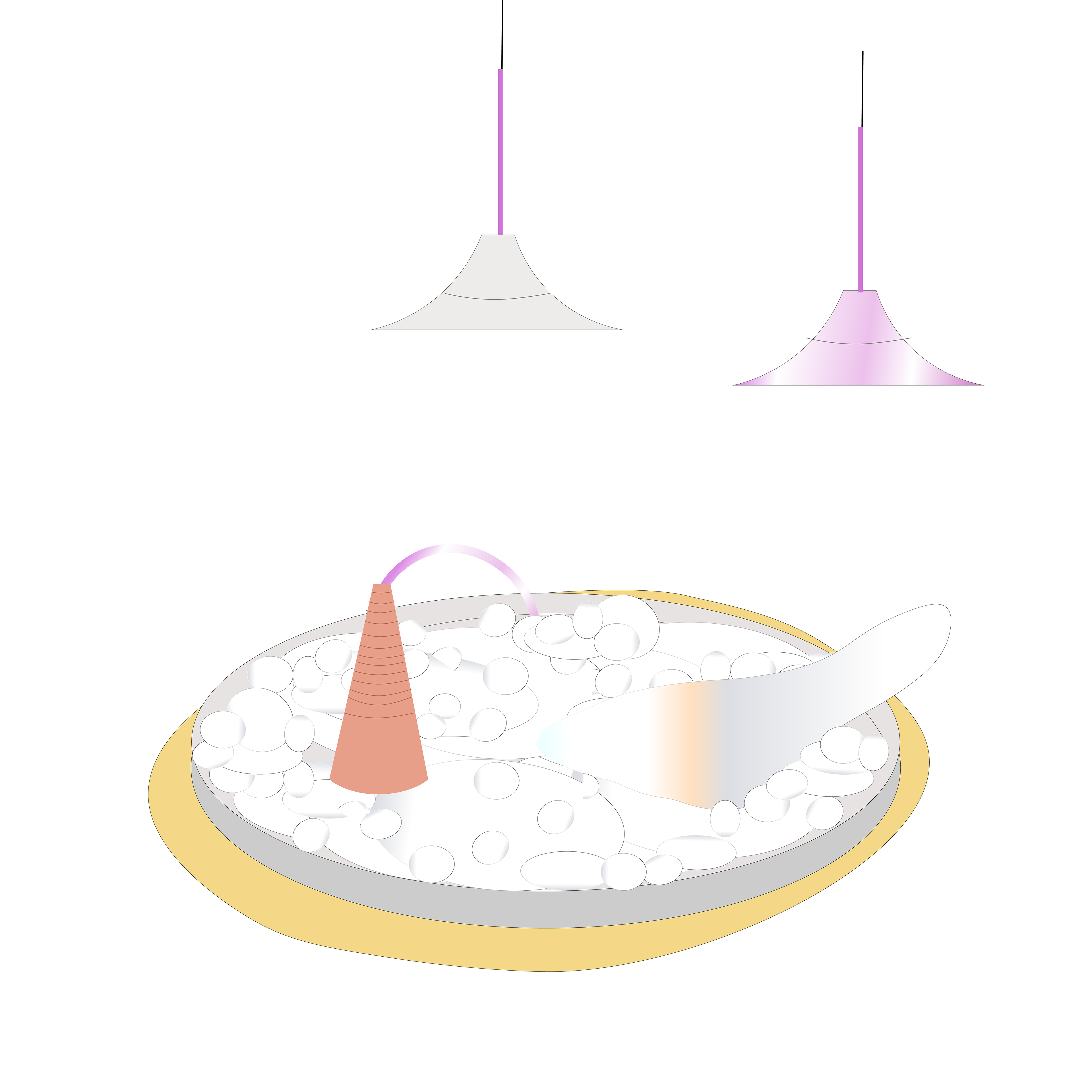
가운데의 하얀 조형물 내부에는 둔부와 꼬리뼈 모형의 뼈대가 들어 있다. 겉으로는 매끄럽고 뭉툭한, 데오드란트나 꽃을 닮은 뽀얀 덩어리가 보인다. 원뿔에 달린 호스에서 물이 뿜어져 나와 이를 때리고, 침식시키며, 녹여낸다. 녹아내린 물은 다시 순환하며 형태를 깎아내는 시스템을 만든다.
달걀 속의 노른자 같은 순간, 혹은 꽃의 수정과도 같아보이는 이 구조는 SM적 관계의 플레이나 비데를 연상시키기도 한다. 코끼리보다는 토끼에 가까운, 슬림한 엉덩이. 관계란 언제나 받는 쪽이 받고, 주는 쪽이 주는 것일까? 여기서는 스스로를 가꾸고, 꾸미고, 유혹하고, 벗기고, 녹이며 거품 같은 환희를 만들어내는 순환이 형성된다. 전시는 매우 절제되어 보이면서도 코지하고, 의아하게 장식적이며, 비누의 점액질처럼 향기롭고, 깨끗하면서도 더럽다. 우아하면서도 천박하고, 세련되어 보이지만 변태적인 뉘앙스를 띠도록 구성해본다.
The content of the exhibition takes the form of a project involving archival practice and social experimentation, yet the experience of it can be synesthetic and abstract. An exchange between brightly dyed flowers and people’s belongings. Through repeated exchanges, materials are gathered with the primary aim of making something ‘flower-like’ again.
Fountain Play is a strange sculptural form that moves between surface and structure, ornamentation and disintegration. Soap offers the hygienic fantasy of something clean and fragrant, yet dissolved within it are materials obtained through exchanges between flowers and people’s belongings. I left the exchanged objects to steep in oil for an extended period in a cool place, producing a cold-infused oil. After straining the oil, I combined it with soap base grated with a cheese grater, kneading the mixture into a sticky mass. What had been a dry, crumbly material gradually became another sculptural mass. Countless invisible materials are extracted into an essence and dissolved into it as flesh that is neither clean nor dirty. Here, it gets splashed with water, all fluffy and bubbly, producing foam.
Speaking of touch in an era when we no longer use the term “flesh-colored,” the installation reflects and absorbs shades of white, gray, yellow, and red within its mechanical metal structure. Material flows and circulates among circles, cones, and parabolic curves, revealing sensations of melting, rusting, getting caught, dampness, and slushiness.
Inside the white sculptural form at the center is a skeletal structure modeled after the buttocks and coccyx. From the outside, it appears as a smooth, blunt, milky mass resembling a deodorant or a flower. Water shoots from a hose attached to the cone, striking it, eroding it, and melting it away. The melted water then circulates back through the system, continually wearing away at the form.
The structure evokes a moment like a yolk inside an egg, or perhaps the fertilization of a flower. It may also bring to mind the play of an S&M relationship or a bidet. A slender butt, closer to a rabbit’s than an elephant’s. In a relationship, is one side always the receiver and the other always the giver? Here, a cycle takes shape in which one tends to oneself, adorns oneself, seduces, strips away, and melts, producing an effervescent kind of ecstasy.
The exhibition is conceived to appear highly restrained yet cozy, strangely decorative, fragrant like the mucous texture of soap, clean yet dirty. Elegant yet vulgar, seemingly refined yet carrying a perverse undertone.